Saturday, October 15, 2011
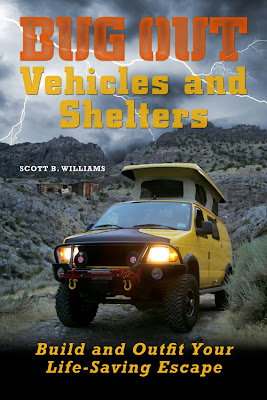
Bug Out Vehicles and Shelters: My Latest Book Now Available
Chapter Three: Bug Out Boats covers the kind of vessels I consider "escape watercraft". That is, both power and sailing craft that can quickly get you out of a danger zone while carrying everything you need to survive, yet are not large enough to offer self-contained, long-term accommodations. These boats include beach cruisers you camp out of, rather than in, and fast runabouts that quickly get you to a safer location in situations where you may not have time to stop overnight at all.
Chapter Six: Liveaboard Boats is in the section of the book dedicated to mobile retreats. This kind of boat provides a platform for long-term survival as well as transportation. Vessels suited for both protected brownwater cruising and offshore bluewater voyaging are included here, with an emphasis on simplicity, seaworthiness and reasonable cost. Outfitting and setting up such a boat as a mobile bug-out retreat is not much different than preparing for any type of long-term cruising in possibly remote locations, but special considerations for this use are pointed out.
Chapter Nine: Human-Powered Watercraft covers canoes, sea kayaks and rowing vessels, as this type of boat can navigate waterways beyond the reach of larger vessels and access remote wilderness areas where safe retreat locations can be found, as well as natural resources for survival. In the event of some kind of sustained shut down of the power and conventional transportation grid, such craft may be the most viable means of travel - especially if stealth and a low profile is needed.
I won't go into many details about the novel project at this point, but I will say that a Wharram catamaran features prominently in the story line. This should probably be expected by long-time readers here, who by now know about my enduring fascination with these Polynesian-style catamarans. A Reuel Parker schooner is also in the story, and a good bit of sailing and passage-making is part of the plot.
The other non-fiction book: Getting Out Alive: 13 Deadly Scenarios and How Others Survived was published back in March this year, and so is not news, but since it was not mentioned here before, I thought I should do so now as it also has some chapters to offer boating enthusiasts. There's a scenario on surviving a hurricane aboard a sailboat, a scenario in which ill-prepared power boaters get swept out to sea in the Gulf Stream, and a modern-day marooning on a deserted Pacific atoll. All these situations include real-life accounts of people who have actually survived (or perished) in similar scenarios.
Monday, December 14, 2009
Paddling the Pascagoula, 1954
As I've mentioned here before, one of the greatest rewards of being an author is hearing from readers of my books about how reading one of them either inspired them to go out and do something adventurous or reminded them of a past pleasure from a similar experience.
This week I got an email from Mike Warnock, a reader of Paddling the Pascagoula who said he could relate to the narrative because he had made his own journeys down the river in the mid 1950's, along with fellow members of Boy Scout Troop 220 of Moss Point.
In the photo above, from 1954, Mike is the kid in the straw hat in the back of the second canoe. He said the longest trip they did on the river was 5 days and 150 miles. They saw few, if any people, and he doesn't remember seeing any of the sewer discharges or trash Ernest Herndon and I reported in our book from our trip in 2004, fifty years later.
Last summer Troop 220 had a reunion at a cabin out from Lucedale, not far from the river (see photo below). Mike is now living in Idaho and is still an outdoorsman. Their Scoutmaster, Sam Wilkes, now 83, is the man in the front center.
I told Mike that I envied those experiences he had at that perfect age for canoeing a river. Though I went on to become fanatical for many years about canoeing and sea kayaking, I never set foot in a canoe until I was 18 years old. Canoeing was almost unheard of around the small town where I grew up, and we did not have an active Scout Troop that did that sort of thing.
Ernest and I have often discussed the fact that Mississippi, a state blessed with woods and water, including thousands of miles of perfect streams for canoeing, just does not have a canoe culture. Even today, anyone paddling a canoe on the bigger rivers of the state like the Pascagoula or the Pearl is looked on with disbelief by the local fishermen in their John boats with outboards. This may never change, but for those of us who do recognize it, this state has some of the finest canoe waters in the country, and the Pascagoula River System surely has some of the finest in the state. I would have loved the opportunity to make such a journey down the river at the age or ten or twelve, but as it turned out there were plenty of opportunities later, and hopefully will be many more in the future.
Thursday, September 4, 2008
Testing the Astral Buoyancy V-Eight PFD

I've been asked on occasion to do equipment reviews for Sea Kayaker magazine. One of the more useful items the editors ever sent me to test was the Astral Buoyancy V-Eight PFD I received from them back at the beginning of summer. I hate wearing any kind of PFD when I'm paddling in hot weather, unless the conditions are so dangerous I just can't justify taking the risk. Usually, you'll see me kayaking with my PFD stuffed under the bungie cords on my stern or foredeck, and most of the time I don't feel I need it unless I'm paddling a surf zone or the wind has picked up enough offshore to build seas large enough to require occasional bracing. On rivers, I don't put one one unless I'm about to run a tricky section of rapids where capsize is a possibility.
This new PFD designed for hot weather paddling may change my mind, though. I tested it in the most miserable conditions imaginable - on a dead still lake in south Mississippi on a typical hot and humid summer afternoon. Here is my assessment of it as published in the current issue of Sea Kayaker magazine, which is on the newstands now:
Astral Buoyancy V-Eight PFD
Reviewed by Scott B. Williams
Sea Kayaker, October 2008
Heat and high humidity are the norm most of the year where I live and do most of my paddling:. the Gulf of Mexico and the slow-moving, swampy rivers that empty into it. Living in the Deep South, I actually prefer hot weather paddling to cooler climates and waters, so when I look elsewhere to travel for kayak touring it’s usually even farther south in the tropics.
Hot weather paddling offers challenges of its own, not the least of which is how to stay comfortable sitting in the cockpit all day under the scorching sun. In cold weather, you can always add more clothing. When temperatures are 90 degrees-plus in the shade and not a breeze is stirring, excess clothing is the last thing you’ll want, and shedding the PFD is also a strong temptation. Paddlers in this kind of heat can often be seen with their PFDs stuffed under the shock cords on their stern or foredecks, and I admit that I’m as guilty as any. Much of the time, the warm and somewhat protected waters I paddle do not merit constant wearing of a PFD, but if it were comfortable enough, I would keep one on anyway.
Most PFDs trap body heat as you paddle, adding greatly to hot weather discomfort. They also chafe bare skin, more of which is exposed when it’s hot as paddlers will likely be shirtless or in a T-shirt or bikini top rather than fully clothed under the PFD. Astral Buoyancy has addressed the need for a comfortable hot-weather PFD with the introduction of their new V-Eight. Billed as “the world’s first breathable lifejacket,” the V-Eight has special contoured foam, which reduces body-to-PFD contact by 70% and has vents ports to allow hot air to escape and fresh air to enter.
I tested the Astral Buoyancy V-Eight by spending a hot June day paddling on Lake Okhissa in the Homochitto National Forest of south Mississippi. This inland lake is surrounded by dense pine and hardwood forests and not a breeze was stirring to bring relief in the 92-degree heat as I paddled for miles over stagnant brown water. This was certainly a day when I would not be wearing my old PFD, as the chances of capsize were slim to none and the water was warm, but I found the Astral Buoyancy V-Eight surprisingly comfortable.
The design places the buoyancy panels high and to the center of the body in the upper back and chest, getting them completely out of the way of the paddle stroke and clear of the rear cockpit coaming. The soft mesh liner on the inside is comfortable against the skin and allows the vent ports to function well. These ports consist of a large rectangular opening in the middle of the back panel and two smaller, oval-shaped openings in each chest panel. The PVC free foam buoyancy panels are dense, but quite flexible and able to contour to the body. The inside surfaces of these foam panels utilize “Airescape technology.” This surface consists of ridges with space between to create air passages and minimize the amount of foam surface in contact with the body. The inside surface of each panel is also specifically contoured to fit the part of the body it will be in contact with. The foam is dense enough to retain its shape after compression, but flexible enough to allow it to contour to the wearer. All the foam throughout each panel is the same material, but glue lines visible in the vent ports indicate that the larger panels, such as the center back one, is laminated from more than one layer.
I found that paddling for hours with this PFD was no nuisance at all and did not feel that it contributed to my discomfort in the heat. The only time I noticed any chafe at all was when the sides of the front panels rubbed against my inner arms while using an extended power stroke, as in sprinting. If additional ventilation is needed, the zipper can be undone completely and the PFD will stay in place with just the front quick-release buckle secured.
When I got into the water to test the V-Eight PFD for buoyancy it easily kept my entire head and face completely clear of the water. With the straps adjusted properly the PFD stayed in place, shifting upward only about an inch while supporting my full weight in deep water. Swimming with the PFD on was natural and unrestricted.
An expandable mesh pocket on the front of the right chest panel provides space for emergency gear such as signaling devices. This pocket is located low on the panel and to the outside of the vent ports in the foam. There is room for a compact VHF radio as well as basic emergency gear. An identical pocket on the other side would allow better distribution of this gear. The placement of the pocket away from the vent ports should not interfere with the venting function. There is a single attachment point for a rescue knife on the right side as well, located above the vent ports. I would prefer to have one of these on each side as well to provide more options for carrying the knife as it may be easier to reach from across the chest rather than on the same side as the drawing hand.
Conclusion: As a hot weather paddler who normally leaves my PFD strapped to the deck, I’m happy to have found a PFD that is specifically designed for my kind of climate. Wearing a PFD at all times is smart, even when it’s hot, and I’m glad the need for a one that is comfortable enough to tolerate in the heat was finally recognized. An additional pocket and attachment point would make Astral Buoyancy V-Eight everything I need in a PFD.
The Astral Buoyancy V-8 PFD comes in red or blue, and is offered in three sizes, measured at widest torso circumference: Small/Medium 31-37”, Medium/Large 38-44”, and Large/Extra Large 45-51”. The buoyancy is rated at minimum 15.5 lbs. at time of manufacture. Shell fabric is 420x210 denier Ripstop Nylon. Liner fabric is Polyester Mesh. Hardware is Acetal Plastic and zippers are self-locking Vislon teeth from YKK. The MSRP is $108.95. Astral Buoyancy Company, 2002 Riverside Drive, Suite 42-A, Asheville, NC 28804. Website: http://www.astralbuoyancy.com/

Thursday, July 31, 2008
Canoeing On Location in the Swamps of Mississippi

I spent the day Monday working as a swamp guide, taking a group of Hollywood filmmakers on a scouting trip to check out possible shooting locations for an upcoming major motion picture that will be shot here in Mississippi next year. This was not the first time I worked on this project. Two years ago when the film was in the early planning stages, my friend Travis Easley and I guided the director and some of his associates on an overnight canoe camping trip along the Leaf River. They came back shortly after that wanting to see some more typical Southern swamp scenery, so Ernest Herndon and I took them to the Pascagoula River. Both trips went exceptionally well, and writer/director Gary Ross was impressed with what he saw and assured me they would be returning to film The Free State of Jones here on location.
That was a little over two years ago, and I didn't hear another word about it until Sunday, when they called wanting to know if I could provide two canoes and take them back to the Pascagoula swamp to for a couple hours on Monday. It was a scramble to get ready on such short notice, but we managed and once again the crew was impressed with what they saw here in the Magnolia State. If things go as planned, some of the scenery in the photos below may be coming to the big screen someday in the not too distant future. I can't disclose the location here, but this will likely be one of many spots in the area that will serve as potential backdrops in this story of Newt Knight and his band of deserters who refused to fight for the South during the American Civil War.

Below: Gary Ross, the writer and director, is well known for his work on such films as Sea Biscuit and Pleasantville. He's a real adventurer who loves getting into the backwoods and has really taken a liking to the remote swamps of Mississippi.

Some of these scenes are undoubtedly little changed from the time this story took place.

Newt Knight and his small army of followers eluded the Confederate troops sent to find them by disappearing into the swamps along the Leaf River in Jones County. It would still be easy to hide out in the wetlands along south Mississippi's rivers and streams.

We saw several small 'gators in just a short stretch of paddling along a dead oxbow lake. Where there are young ones, there have to be some big adults as well. The alligator population has really been on the rise here in recent years.

I'm looking forward to more of this kind of location scouting work in the coming weeks and months as this film comes closer to reality. It will be quite an experience to see how a production crew works in such a difficult environment, and it will be awesome to go to the movies and see the woods and waters I have loved all my life on the big screen.
Bernard Moitessier - A Sea Vagabond's World
Popular Posts
All Posts by Topic
- wharram catamarans (35)
- boatbuilding (28)
- boat design (20)
- sailing (15)
- voyages (14)
- boat designers (13)
- boat for sale (11)
- kayaking (11)
- misc. (9)
- boating gear (7)
- book review (7)
- videos (7)
- canoeing (6)
- seamanship (6)
- boat buying (5)
- cruising (5)
- launchings (5)
- online resources (5)
- boat camping (4)
- boat refit (4)
- boatbuilding materials (4)
- magazines (4)
- monohulls (4)
- my books (4)
- rivers and swamps (4)
- sailboats (4)
- survival (4)
- Gulf of Mexico (3)
- James Wharram (3)
- boat shows (3)
- sailing fiction (3)
- sharpies (3)
- Cape Dory 27 (2)
- Caribbean (2)
- Carl Alberg (2)
- Kruger Canoes (2)
- Kruger Sea Wind (2)
- Reuel Parker (2)
- boat maintenance (2)
- boat review (2)
- gear review (2)
- marine carpentry (2)
- multihulls (2)
- navigation (2)
- oil spill (2)
- other stuff (2)
- paddling (2)
- projects (2)
- Sailing the Apocalypse (1)
- beachcruising (1)
- book giveaway (1)
- circumnavigation (1)
- cruising destinations (1)
- dinghy (1)
- environment (1)
- expeditions (1)
- great deals (1)
- living aboard (1)
- proa (1)
- rowing craft (1)
- ships (1)
- the sea (1)