Wednesday, October 10, 2012
Beachcruising
While there are some large, shoal-draft cruising sailboats that can go right up the shore and safely dry out at low tide, this Endeavor 37 Ketch that was also beached on the island is definitely not one of them:
This sailing yacht was obviously left hard aground by the storm surge of recent Hurricane Isaac. She's a good 40 or 50 yards from the water's edge now, and at 20,000 lbs. displacement, will not be easy to refloat. I don't know where she was before the storm and how she came to break loose and end up on the beach at Deer Island, but seeing this is a good reminder of just one of the things that the owners of small, beachcruising sailboats and sea kayaks don't have to worry about.
Monday, July 2, 2012
Book Review: Across Islands and Oceans
Sunday, January 11, 2009
Making a Rope Bow Fender
My friend David and the crew at Boatsmith recently completed construction of a lapstrake pulling boat to Iain Oughtred's Guillemot design. This vessel will be the new tender to the 1929 Alden schooner, Summerwind. David's construction photos and more can be seen at his blog on the project.
Below is one photo of the mostly-completed tender:
Knowing that my girlfriend, Michelle, is quite accomplished at decorative ropework, David called me last week to see if she could produce a bow fender or "bow pudding", as it is correctly termed, on short notice - like over the weekend. The fender was in the contract for the finished dinghy, but David couldn't find anyone who could make one without a lead time of more than a month or two. Michelle has done lots of ocean plait doormats, turks head bowls and monkey's fist key chains and the like, but making a fender was new territory until this project came along.
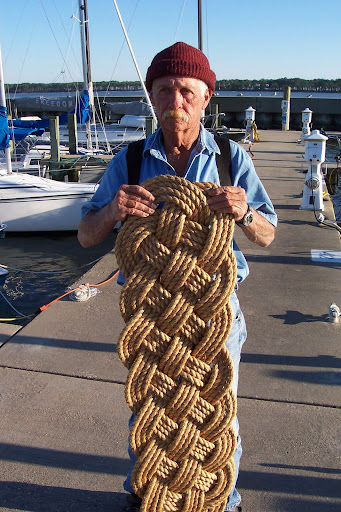
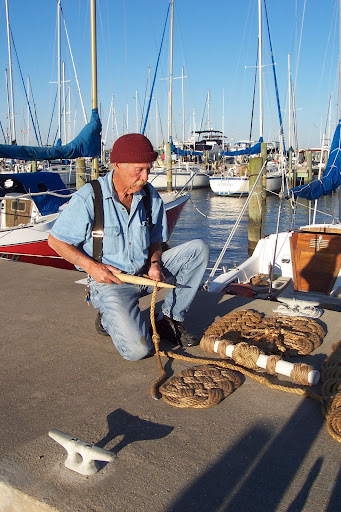
Michelle was first introduced to nautical ropework by the late Captain Charley Strickland, who we met at Point Cadet Marina in Biloxi when I still had Intensity docked there. Although we only had the privilege of knowing him for a few short months before he passed away in 2005, he gladly shared everything he learned in a lifetime as a professional seaman and was delighted to find Michelle an eager student of the art of knots. Below is a photo I took of Captain Charley with some of his work on the dock at Point Cadet. More about him can be found in an article I wrote for The Sun Herald that was also posted here.
Knowing Captain Charley would be proud of her continued efforts and not lacking in confidence in her ability to learn new tricks, Michelle told David she could deliver the fender on time. She pulled out her reference books, including the classic, Ashley Book of Knots to get some ideas. None of them showed a fender like David described, but by studying the various drawings, we came up with a plan and I helped her make the seized eyes and build up the core so she could do her thing on the decorative covering.
Below is close-up of one of the eyes, made by seizing a loop of 1/2" manila.
The eye with additional strands of rope doubled back from the other end to form the bulk of the core.
David's specifications for the bow fender required a length of 36 inches for the protective part, with 3-inch eyes at each end, for a total length of 42 inches. The piece of rope used to make the eyes was doubled back several times so that the core would consist of single piece of line in the center. He wanted the finished thickness to be 3 inches at the ends and 5 inches in the mid-section.
The taper from the thicker mid-section to the narrower ends was created by adding more varying lengths of 1/2" manila and binding them in position with smaller cord. The bent shape was also created at this stage by the binding, with longer pieces on the outside of the curve and shorter pieces on the inside radius.
The covering method Michelle decided to use consists of a series of continuous half-hitches, using 1/4" manila. This half-hitching method works well for covering a tapering surface, and provides plenty of cushioning bulk for the fender. Since it also is flexible and fits loosely over the core, the fender can easily be bent further to fit to the bow of the boat.
That's a lot of half-hitches and over 200 feet of 1/4-inch manila.
It takes a lot of patience to tie all those knots when you have to pull 50 or more feet through each time and fight the rope's tendency to unravel and twist.
Here's a closer view of one end of the fender, showing how the knots conform over the taper and form the rounded end at the eye.
The finished fender came out to just the right size. It will be smoothed out and bent to just the right shape when installed on the boat. David has installed a rope rub-rail made from 1 1/2-inch thick manila all around the perimeter of the boat. The bow fender will be lashed at the eyes and pulled up right to the rope rubrail.

I plan to travel to Florida next week to help David with some interior work on the Summerwind. The new tender with its bow fender will be delivered to the schooner while I'm there, so I should be able to get some additonal photos of it installed as well as photos of the schooner to post when I return.

Tuesday, June 24, 2008
A Dream Destroyed: Charlie's Resolution Shipwrecked
Below: Charle's Whipple's self-built Resolution - a sturdy little offshore cruiser built to handle the conditions of the Southern Ocean. The boat was just launched in April of this year, and now sadly, has been wrecked on the rocky coast of New Zealand in the first leg of a planned voyage around the world.
I've been checking in on Charlie Whipple's blog about the building of Resolution for more than two years now, since I first read an article in Small Craft Advisor about his plans to build the John Welsford Sundowner design and sail it around the world. It caught my attention because it was an interesting design: a small, but heavily-built displacement cruiser designed to handle a circumnavigation by way of the southern capes. Charlie Whipple's planned solo voyage around the world was an ambitious undertaking, but with dogged resolution he completed the first stage: building the stout little boat in two and a half years under the guidance of the designer at his shop in New Zealand.
Though only 21-feet long, this is one big pocket cruiser, and no small construction project to undertake, as you can see below in this photo of Charlie working in the cockpit before the decks were on.
John Welsford is known for designing beautiful small boats, and even many of his open boats have undertaken impressive offshore voyages. The Sundowner design was specifically drawn for Charlie's requirements as an evolution of Welsford's tiny offshore cruiser design he called Swaggie. Simplicity of systems were a priority in these requirements, but no compromises were to be made in the area of strength. The result was one stout and good-looking little voyager. Below you can see Charlie at the dock with Resolution shortly after the launching.
I learned of Resolution's tragic end just this morning as I browsed through the latest threads on the Sailfar.net forum. (The thread can be found at this link). There are also links from this thread to some video footage of the boat awash in the surf off a rocky shore. Charlie was rescued unhurt by a search and rescue helicopter after setting off a distress signal from his EPIRB.
Though his boat could have probably survived anything he would have likely encountered out at sea, what did him in was the rocks of land as he apparently got off course near shore while sleeping or extremely fatigued. This is always a danger of singlehanded sailing and illustrates again how boats are safer far at sea than anywhere near land. This same scenario has been repeated over and over and could happen to anyone who pushes themselves to exhaustion on a singlehanded or shorthanded voyage where getting enough rest is difficult. Even the great singlehanding legend, Bernard Moitessier lost his boat Marie-Therese II in the same manner in the West Indies. Having experienced hallucinations myself while trying to stay awake at the helm for more than 36 hours, I know all too well how disoriented one can become.
I really hate to hear about the loss of such a fine little boat after so much hard work was put into building her. I was really looking forward to reading Charlie's voyage reports as he made his way around the world, and I wish him the best now in whatever he does, whether it means starting over or moving on to a different dream. Having lost a cruising boat to a hurricane myself, I can relate in some way to pain he must feel.
Thursday, June 12, 2008
Montgomery 17 Trailer Sailor Crosses the Pacific
This is Strawanza, a custom-built Montgomery 17 trailor sailor that has crossed most of the Pacific and is enroute to the West coast of Africa.
How big does your sailboat have to be to cross an ocean? If you believe what most of the writers in the yachting press would have you believe, you need at least a 40-footer. At least that was the case until recently. In the current issue of Sail, the typical advertising-driven sailing rag with glossy full page ads for yachts costing a half a million dollars or more, the "new boat roundup" cover story attempts to explain why 50' is the new 40'. The article, entitled: Life Begins at 50, profiles 38 production sailboat designs ranging in size from 50 to 60 feet.
It seems that for some reason most boat owners are always craving a larger boat, no matter what size they currently sail. According to the article, average boat size has been on the rise for years, and the author claims this is a logical progression from the days when most boats in any given harbor were under 40 feet. Logical? Please tell me why? The sea hasn't changed since the 1950's, 60's and 70's when all kinds of adventurers like John Guzzwell, Robin Lee Graham, Tania Abei, Lin and Larry Pardey and countless others were circumnavigating the globe in boats under 30 feet. What has changed is that navigation equipment, communications technology, safety gear, and boat construction methods have gotten much better. So you would think that small boat voyaging would be more popular and more doable than ever before and with a greater margin of safety.
The truth is, there are still a lot of adventurous sailors out there making incredible voyages in small boats. Just after flipping through this latest issue of Sail magazine, I came across a link on the Sailfar.net forum about a Montgomery 17 trailer sailor making landfall in Vanuatu. That may not sound all that extraordinary until you read further and see that this single-handed voyager departed from the coast of California.
Willi, an experienced solo sailor from Austria, commissioned a custom crafted Montgomery 17 from Montgomery Boats in Dana Point, California. He had read about the Montgomery 17's racing record, the strength of its construction, and proven seaworthiness of the Lyle Hess designed pocket cruiser. Montgomery 17's have cruised the Caribbean, sailed from California to Hawaii and from Cape Hatteras to San Diego via the Panama Canal, and sailed the length of the Mississippi. Many others have crossed the Sea of Cortez and have made countless trips to Catalina and the Channel Islands.
Willi's voyage is perhaps the most ambitious of them all, however. His homeport and yacht club is in Namibia, on the West coast of Africa. He will sail his custom Montgomery 17, which he christened Strawanza down the coast of California from San Diego, across the Pacific, then cross the Indian Ocean, to round the Cape of Good Hope and up the West coast of Africa to home. Planned time enroute, including stopovers is around 15 months.
The photo below gives you an idea just how small a Montgomery 17 is, but despite appearances, this is a boat that can go to weather, is self-righting and can carry food, water, supplies and safety gear for 100 days at sea.
The Norvane Self Steering gear bolted on the transom is not something you see every day on a trailer sailor. Many more photos and descriptions of the modifications done to Strawanza can be found here.
There's no question that crossing oceans in a 17-foot sailboat is not for everyone, but then again, neither is owning a 50 to 60-foot luxury yacht. There are a lot of happy mediums and lots of boats in the 20-32 foot range that can do the job in safety, a degree of comfort, and for a reasonable outlay in purchase price or refitting of a tired, old example. Voyages like Strawanza, serve as inspiration and reassurance for those of us who want to go to sea but don't want to grow old being melon farmers while trying to earn enough to pay for the boats magazines like Sail tell us we should be sailing.
Saturday, January 12, 2008
Remembering Captain Charley
Here' s an article I wrote for the Sun Herald's South Mississippi Outdoors and Recreation magazine about Captain Charley, one of my neighbors at Biloxi's Point Cadet Marina.
Captain Charley: A lifetime working with ropes
“With old sailors it was, and is, a matter of pride to be able to make knots, the more difficult and obscure the better.” Page 323, The Ashley Book of Knots
Captain Charley Strickland, Ret., is a seaman, and by his estimation, being called by that term is the highest honor anyone could bestow upon him. He was born in a tarpaper shack in Hardin County, Texas in 1938, and like his father and grandfather and most of the men in his family, soon found his way to sea. His first job was aboard a tug working the Gulf Coast of Louisiana and Texas, and that’s where he began his apprenticeship as a seaman.
From day one on board his first vessel, Charley learned the importance of rope. “Rope is literally the ‘lifeline’ of every vessel and is the most essential equipment on board” Charley says. His first job on board the tug was to make the rope fenders necessary to bring the boat alongside another vessel or a dock without damage, and to this day he prefers these “seaman-like” fenders to the inflatable plastic ones most modern boaters buy from discount stores. He learned to make the massive bow and stern pieces called “bow pudding” and “stern pudding and learned to make the traditional “monkey’s fist” knot in the end of a heaving line that enables one to throw it to another crew member on a dock or other vessel even in high winds. He learned to tie bowlines and clove hitches and make eye splices, end splices and short splices for joining two pieces of rope. In addition to these everyday knots in constant use aboard a working vessel, he learned to tie the more elaborate and obscure endless knots called “Turks heads” and to make plaited mats of rope.
Captain Charley’s career on working boats included holding practically every position on board a vessel at one time or another. He has worked as a cook, chief engineer, able-bodied seaman, mate and master. As a captain, he worked all over the southern Gulf of Mexico, operating for years out of such ports as Ciudad del Carmen, Dos Bocas, and Tampico. Although he left the sea for awhile to work on high steel as a master rigger on a construction job, his love of boats soon overcame the appeal of higher pay and he found his way back to his beloved Gulf. Captain Charley believes that seaman are made, not born, and that most men that have it in their blood would work for free if that’s the only way they could go to sea. He admits that being a seaman can be a lonely life, and that it’s hard to be a family man and spend a life at sea. He’s been married several times, but now lives with his dog, Hobo, on a small sailboat that he hopes to soon trade for a larger one that will be a more comfortable home. He also plans to voyage back to the Mexican coast he knows so well when he acquires and properly equips his new boat.
To Captain Charley it’s an atrocity to see a boat improperly tied up and to see so many modern sailors who have little regard for their boats or for taking care of the lines on board them and learning to tie proper knots. He says he looks at a boat the way a younger man looks at a woman, and that he’s never seen an ugly boat. “If anybody thinks it’s ugly, let it pull alongside when he’s sinking…” he says.
Captain Charley is adamant that anyone who goes to sea should know how to tie a variety of traditional knots and should have a splicing fid on board to make splices. He’s happy to teach anyone who shows the slightest interest in seamanship. There’s nothing he would rather do with is his time than teach his craft, especially to youngsters, as he believes these skills are a dying art.
Captain Charley can be found most any day at Slip D-39 in Point Cadet Marina. He may soon trade up to that larger boat, but you’ll know which one is his by the rope mats on deck and the monkey’s fist knots hanging from the boom. Anyone who is interested in learning more about traditional marlinspike seamanship can talk to Captain Charley at the Gulf Coast Wooden Boat Show on May 14-15. He’ll be there displaying a variety of rope mats, decorative knots, and even his version of knot art in the form of rope sculptures.
(This article was first published in South Mississippi Outdoors and Recreation,April 2005, then on Island Time Online on 5-5-2005)
Captain Charley passed away just days before Hurricane Katrina devastated the Mississippi Gulf Coast, and just a few short months after I interviewed him and took these photos.
Bernard Moitessier - A Sea Vagabond's World
Popular Posts
All Posts by Topic
- wharram catamarans (35)
- boatbuilding (28)
- boat design (20)
- sailing (15)
- voyages (14)
- boat designers (13)
- boat for sale (11)
- kayaking (11)
- misc. (9)
- boating gear (7)
- book review (7)
- videos (7)
- canoeing (6)
- seamanship (6)
- boat buying (5)
- cruising (5)
- launchings (5)
- online resources (5)
- boat camping (4)
- boat refit (4)
- boatbuilding materials (4)
- magazines (4)
- monohulls (4)
- my books (4)
- rivers and swamps (4)
- sailboats (4)
- survival (4)
- Gulf of Mexico (3)
- James Wharram (3)
- boat shows (3)
- sailing fiction (3)
- sharpies (3)
- Cape Dory 27 (2)
- Caribbean (2)
- Carl Alberg (2)
- Kruger Canoes (2)
- Kruger Sea Wind (2)
- Reuel Parker (2)
- boat maintenance (2)
- boat review (2)
- gear review (2)
- marine carpentry (2)
- multihulls (2)
- navigation (2)
- oil spill (2)
- other stuff (2)
- paddling (2)
- projects (2)
- Sailing the Apocalypse (1)
- beachcruising (1)
- book giveaway (1)
- circumnavigation (1)
- cruising destinations (1)
- dinghy (1)
- environment (1)
- expeditions (1)
- great deals (1)
- living aboard (1)
- proa (1)
- rowing craft (1)
- ships (1)
- the sea (1)